• How to Articles RSS Feed

    Published on 11-16-2011 08:13 PM
    Article Preview

    When a Club Hosts a Speaker
    by Steven Pro

    As an aquarium society grows, they inevitably want to bring in out of town experts to educate their membership. The first thing that the club leadership needs to determine is, what would the members like to hear about? Do they want to hear the latest on reef aquarium lighting or would they prefer to discover the most recent breakthroughs in marine fish breeding? Some clubs prefer hands-on workshops on things like coral fragmentation, aquarium photography, aquascaping, fish necropsy, or acrylic and PVC fabrication. While other clubs might prefer more formal, educational lectures or picture heavy travelogues. Once it has been decided what the club is looking for, finding a speaker to fill that niche is much easier.

    The Marine Aquarium Society of North America (www.masna.org) provides a database of speakers, their contact information, and their specific requests to provide lectures and/or workshops to their member clubs. I urge you to take advantage of this resource, but if there are speakers not listed, do not hesitate to ask the board so that they can assist in locating and contacting the speaker. MASNA is also pleased to make suggestions ...
    by Published on 10-14-2011 05:24 PM
    Article Preview

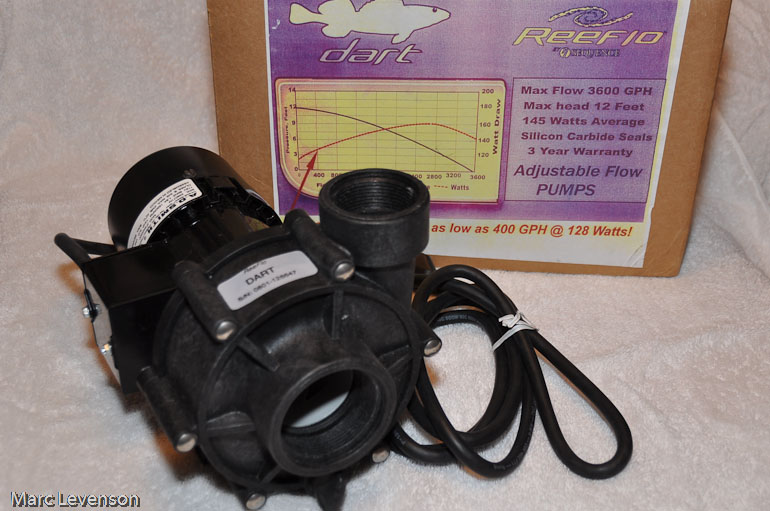
    My reef uses two Dart pumps. One is used as a return pump, the other as a means to feed all equipment with a manifold of valves. The return pump started making noise about a week before I had to fly to MACNA 2011. Swapping the noisy pump out with my back up Dart pump wasn't an option; that one leaked at the seal so the noisy one was re-installed.


    In the past six weeks, the noise level had only gotten worse and worse. Buying a new pump was the obvious solution, but this one was only used for 8 months, and my funds were spent elsewhere. My friend Bobby told me we could replace the bearings and correct the problem. He had me order bearings found on Ebay. I found a package of 10 for $11.50 with free shipping, sold for skateboarders.


    Within a week, the bearings arrived. I also had a new seal at the ready.


    The pump was easily removed from the plumbing by unscrewing the union valves.


    The first thing to remove is the impeller housing. There are six nuts that need to be removed to pull off the cover.


    With the cover out of the way, the impeller is visible.


    Not pictured is how the cooling fan cover at the end of the pump was removed. Next, a flat-head ...
    by Published on 12-24-2010 01:10 PM
    Article Preview

    Bulkheads are a necessary part of a drilled tank to drain water down to the sump. They also are used on sumps running external pumps. A bulkhead is a plastic fitting with a flange, rubber gasket and retaining nut. They come in many sizes, both in Schedule 40 (standard) and Schedule 80 (beefy/sturdy). These are purchased at your local fish store (LFS) or online from various e-tailers. You won't find them at Home Depot or Lowes, but some smaller chains like Elliott's Hardware have some in inventory. Plumbing supplies won't have them usually.
    ...
    by Published on 12-22-2010 01:59 PM
    Article Preview

    For many years, I have received hundreds if not thousands of requests for help with plumbing. An article is what was needed, and at last you will get your wish. The first thing you need to know is that there are many ways of accomplishing the same thing, and the most often reason for this is a lack of available parts. Even with a clear plan in mind, sometimes it requires buying alternate pieces to get the same results. The trick is knowing what is available to use, ...
    by Published on 10-29-2010 02:15 AM
    Article Preview

    There is always someone who is just starting in this hobby and may not know some of the things we take for granted. I'm all about documenting step-by-step instructions for just about anything and everything I do so that one day, someone can google it, and find a reassuring article on what they are about to venture forth and do. Having said that, I had to rinse out and reuse my old sand from my 150-gallon tank. This sand had sat in a large 50 gallon trash can on the side of my parents house for over 18 months. Open to the elements and rain. But, hey why not make use of it for the next tank!?
    ...
    by Published on 08-03-2010 01:00 AM
    Article Preview

    To maintain crystal clear water quality, I find that it is essential to use granulated activated carbon (GAC) in my system. GAC is sold everywhere, and brand names are often compared. The key to picking out a good carbon is one that doesn't release a lot of dust into the tank and doesn't contain any trapped phosphates. I've seen many sumps that contain a mesh bag (or a nylon stocking) packed full of carbon, which the hobbyist believed would help water quality. This is called passive filtration, and it is an inefficient way to utilize carbon. Over time, a film or skin develops over the mesh material and water simply passes over and around it instead of flowing through it. Instead, I opt to put GAC in a Phosban Reactor (made by Two Little Fishies), where water is pumped through the media. This is called active filtration, and what I recommend to everyone.
    ...
    by Published on 07-19-2010 04:45 PM
    Article Preview

    This article contains multiple pages and over 200 images.

    It’s the sound no one wants to hear. It’s the visual we pray will remain only a dream. It’s the fear we’ve often considered, all the while hoping to outwit this worst case scenario with every ploy conceivable.

    Even with the most careful planning, time marches forward. Hour by hour, pressure stresses and tugs at the very seams that hold your reef tank together. Gravity is relentless, and age tears at the surfaces above and below the water, weakening the aquarium. Warranty or not, eventually something is going to give. What you do next dictates how this dance plays out.

    I can’t help but wax poetically about the recent shift that my reef tank took. I put a lot of time, pride and money into making it the beautiful piece of the ocean it was, only to discover a seam failing. With the carpet gradually absorbing more and more water, my reef slowly began to “bleed” to death. The fish swam about unawares, just thinking about their next meal. The corals were growing quietly, swaying in the current, blissfully ignorant of the enormity of what was to come. And all the while, their caregiver was trying to determine the best option under the circumstances.


    This is the story of the end of my 280g reef. It was going to turn six years old in 50 days, still well in its prime. Corals were thriving, intertwined and yet tolerating one another for the most part. Some were losing ground as their closest neighbor gained another inch or so. The water was sparkling, the parameters perfectly suited for their needs. Yet their home, the 37.5 cubic feet they shared, was letting go. Below, a bunny was cleaning himself, without knowledge of the impending rush of water that was likely to pour his way had I not noticed the wet area spreading nearby. Perhaps I should be grateful for the 2141 days that those seams held, instead of feeling the loss so strongly. Fortunately I was home when this happened. After all, I was scheduled to be in Austin that weekend.

    On July 2nd, as I was heading out the front door of my home, I heard my shoe squeak slightly on the tile. We’d had a great deal of rain and I dismissed it, thinking my carpet was a little moist from recent foot traffic. On July 3rd, the squeak was far more pronounced, causing me to pause. Fighting back my dismay, I quickly studied the angled-front 20-gallon tank in the entry, but all was dry as was the tile beneath. I checked inside the adjacent closet to see if the plumbing was leaking, but it too was as it should be. Walking backwards slowly as I felt the carpet with my fingertips, I tracked the wetness back to the left column of the woodwork that wraps my 280-gallon ...

    Page 1 of 3 123 LastLast